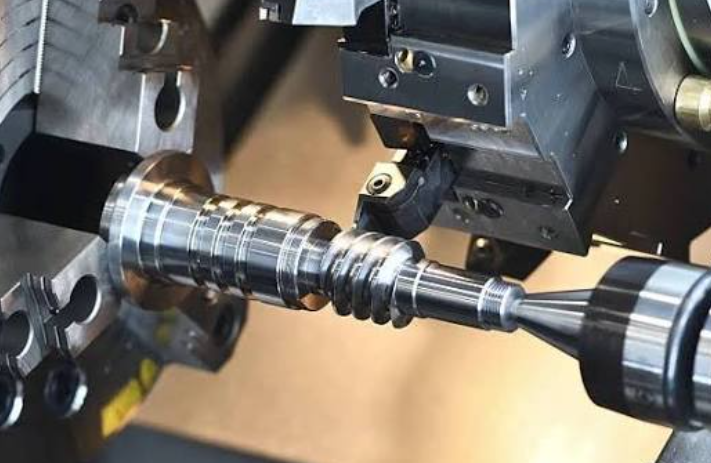
Spindle liner sizing determines how effectively a CNC lathe supports bar stock while it rotates inside the spindle. A correctly sized liner reduces unnecessary clearance around the bar, helping control bar movement, vibration, noise, and machining instability.
The liner cannot simply be “close enough” to the nominal bar diameter. Proper spindle liner sizing should account for the actual bar outside diameter (OD), material condition, bar shape, machine configuration, and the amount of clearance required for that specific application.
For many standard applications, spindle liners are commonly sized approximately 0.030″–0.060″ over the diameter of the bar being machined, although the correct clearance is application- and material-dependent.
What Is Spindle Liner Sizing?
Spindle liner sizing is the process of determining the appropriate inside diameter (ID) of the liner relative to the outside diameter of the bar stock.
A spindle liner reduces the available ID inside a CNC lathe spindle or draw tube. Without that reduction, smaller bar stock may have significant open space around it.
As spindle speed increases, unsupported bar stock can begin moving within that space. Proper sizing limits how far the bar can move while still providing enough clearance for the material to rotate and feed through the machine.
The basic relationship is:
Spindle liner ID = actual bar OD + appropriate operating clearance
The difficult part is determining what that operating clearance should be.
Clearance that works for one material or machine configuration may not be appropriate for another. Bar condition, straightness, surface finish, geometry, and production requirements all need to be considered.
Why Does Spindle Liner Clearance Matter?
Clearance controls how much room the bar has to move inside the liner.
Too much clearance reduces the liner’s ability to support the stock. Too little clearance can interfere with loading, feeding, or normal dimensional variation in the material.
The objective is not to make the liner as tight as possible. It is to provide enough clearance for reliable operation without leaving unnecessary room for bar movement.
What Happens When a Spindle Liner Is Too Large?
An oversized liner leaves excessive space between the bar OD and liner ID.
As the bar rotates, that additional space gives it more opportunity to move away from the spindle centerline. Depending on the application, excessive movement can contribute to:
- Bar whip
- Vibration
- Chatter-related machining problems
- Excessive liner noise
- Poorer surface finishes
- Reduced machining stability
- Additional stress on the overall bar-support system
A spindle liner is intended to control the portion of the bar extending behind the chuck. If its ID is substantially larger than necessary, the operator loses some of that control.
This is why the approved JF Berns spindle-liner guidance identifies correct clearance over the actual bar OD as one of the primary factors affecting liner performance.
What Happens When a Spindle Liner Is Too Small?
Undersizing creates a different set of problems.
The bar must have sufficient room to enter, rotate, and feed through the liner without binding. A liner sized only from a nominal material dimension may not provide that room if the actual stock measures larger.
This is particularly important with material that may be:
- Oversized
- Hot rolled
- Not perfectly straight
- Non-round
- Subject to meaningful dimensional variation
A liner should therefore be sized from the material that will actually run through the machine rather than relying exclusively on the number printed on a material order.
Why Should You Measure the Actual Bar OD?
Nominal bar diameter and actual bar diameter are not always identical.
That distinction matters because the spindle liner has to accommodate the physical material entering the machine.
JF Berns specifically asks customers whether material is hot rolled or oversized and, when applicable, what the stock actually measures. Its spindle liner specification process also considers bar stock sizes and whether the material is round, hexagonal, or square.
For manufacturers specifying a new liner, measuring representative pieces of production material can provide a more useful starting point than relying only on nominal dimensions.
The goal is to understand the actual envelope that must pass through the liner.
What Factors Affect Proper Spindle Liner Sizing?
Bar diameter is the starting point, but it is not the only factor.
A technically sound sizing decision should consider the complete application.
| Sizing Factor | Why It Matters |
| Actual bar OD | Establishes the physical diameter the liner must accommodate |
| Bar material | Different materials and manufacturing methods can affect dimensional consistency |
| Bar straightness | Less-straight material may require additional application consideration |
| Bar shape | Round, hex, square, and other stock may require different support strategies |
| Bar length | Longer rotating stock can increase the importance of effective support |
| Machine make and model | Determines the spindle and draw-tube configuration |
| Draw tube ID | Helps establish how the liner must fit within the machine |
| Bar feeder or loader | The liner must function with the surrounding bar-handling system |
| Production conditions | Operating requirements influence the appropriate clearance and configuration |
The correct spindle liner should be treated as part of the entire machine setup rather than an isolated tube with a specific ID.
How Does Spindle Liner Sizing Affect Vibration and Bar Whip?
Proper sizing limits the distance rotating bar stock can move away from its intended centerline.
When significant clearance exists between the bar and the surrounding spindle or draw tube, stock extending behind the chuck can begin to whip as rotational speed increases. JF Berns describes controlling that movement as a primary reason for using a spindle liner.
Clearance is not the only variable involved.
Effective bar control also depends on factors including:
- Bar straightness
- Liner straightness
- Liner rigidity
- Bar diameter
- Bar length
- Spindle speed
- Machine configuration
A properly sized liner cannot compensate for every mechanical problem in a CNC lathe. However, unnecessary clearance introduces another variable into a system where manufacturers are generally trying to control movement as precisely as possible.
Why Straightness Matters Along With Sizing
A correctly sized liner still needs to remain straight and properly centered.
Imagine a liner with the correct ID but an internal centerline that moves noticeably along its length. The bar would still encounter inconsistent support as it rotates.
For that reason, sizing, straightness, and rigidity should be evaluated together.
JF Berns’ metal spindle liners are straightened to 0.005″ total indicated runout (TIR), allowing straightness to be measured and verified.
This illustrates an important distinction in spindle liner specification: correct diameter is necessary, but diameter alone does not determine performance.
See also: Building a Business That Customers Love
Do You Need Different Spindle Liners for Different Bar Sizes?
Manufacturers running multiple bar diameters should not assume that one large liner can efficiently support every smaller size.
As bar diameter decreases while liner ID remains unchanged, clearance increases. At some point, the liner is no longer providing the level of bar control for which it was intended.
Production environments running several standard bar sizes should evaluate whether dedicated liners are appropriate for those diameters.
This can also make setup more repeatable. Permanently identifying liners by size or part number helps operators select the intended liner during changeovers rather than estimating which liner is close enough.
How Should a Shop Size a New Spindle Liner?
A practical spindle liner sizing process begins with gathering accurate application information.
1. Identify the CNC Lathe
Record the machine manufacturer and model.
Machine-specific information helps determine how the liner needs to fit inside the spindle or draw tube and how it will be retained.
2. Determine the Actual Bar OD
Do not rely automatically on nominal material size.
Measure the stock when dimensional variation, hot-rolled material, or oversized material could affect fit.
3. Identify the Material and Shape
Specify whether the stock is round, hexagonal, square, or another geometry.
Also identify the material and any unusual surface or dimensional conditions.
4. Determine Bar Length
Bar length affects the complete support application, particularly when material extends beyond the standard spindle arrangement.
5. Review the Bar Feeder or Loader
If the machine operates with a bar feeder, bar loader, bar puller, or other material-handling equipment, that equipment should be considered during liner specification.
JF Berns’ quote process, for example, requests information including lathe make and model, bar feeder make and model, draw tube ID, bar stock size, bar length, material condition, stock shape, and bar-feed channel or pusher size.
6. Establish the Required Clearance
The liner manufacturer can then determine an appropriate liner ID based on the complete application.
This is preferable to arbitrarily adding clearance to the nominal bar size without considering how the stock and machine actually operate.
How Can Correct Spindle Liner Sizing Improve an Operation?
Correct sizing can influence several areas of CNC lathe performance simultaneously.
More Stable Bar Support
Reducing excessive space around the bar limits unnecessary movement within the spindle.
Better Vibration Control
A properly supported bar has less opportunity to develop the uncontrolled movement associated with excessive clearance.
More Consistent Machining
Reducing unnecessary movement helps create more stable cutting conditions. The exact machining result still depends on tooling, workholding, speeds, feeds, material, and machine condition.
Easier Troubleshooting
When liner sizing, straightness, and mounting are known to be correct, operators can eliminate several variables when investigating vibration or bar-support problems.
More Repeatable Setups
Dedicated, properly identified liners can make it easier for operators to establish the intended support arrangement when switching between bar diameters.
Why Spindle Liner Sizing Is Also a Safety Consideration
Spindle liners support rotating material, making proper sizing more than a productivity issue.
Excessive unsupported bar movement can become hazardous as rotational speed increases. A liner should also be securely mounted so that the support system itself cannot move unpredictably during operation.
If bar stock extends beyond the lathe spindle, proper spindle liner sizing does not eliminate the need for appropriate external support and containment. JF Berns notes that rotating material extending beyond the spindle requires suitable bar support to help protect against bar whip.
Manufacturers should evaluate the complete rotating-bar system, including the spindle liner, bar feeder, loader, external supports, guarding, and machine configuration.
Why Application-Specific Spindle Liner Engineering Matters
Spindle liner sizing looks simple because the concept can be reduced to bar diameter plus clearance. In practice, reliable sizing requires more information.
JF Berns manufactures machine-specific spindle liners and uses application information such as machine model, draw tube dimensions, bar size, actual material dimensions, bar shape, and feeding equipment when specifying liners.
The company has also manufactured both steel and hybrid urethane spindle liners. Its published engineering guidance emphasizes 3 fundamental variables in spindle liner performance: correct bar clearance, liner straightness, and rigidity.
For manufacturers adding a new bar diameter or correcting an existing bar-support problem, working from actual application data reduces the likelihood of treating liner sizing as guesswork.
Frequently Asked Questions
How much clearance should a spindle liner have?
The required clearance depends on the material and application. JF Berns states that spindle liners are commonly sized approximately 0.030″–0.060″ over the bar diameter, but the appropriate clearance should be determined from the actual operating conditions.
Should a spindle liner be sized from nominal or actual bar diameter?
Actual bar OD should be considered, particularly when material is oversized, hot rolled, or subject to dimensional variation. The liner must physically accommodate the material that will run through the machine.
Can a spindle liner have too much clearance?
Yes. Excessive clearance gives rotating bar stock more room to move inside the liner, reducing the effectiveness of the support and potentially contributing to bar whip, vibration, and noise.
Can spindle liner clearance be too tight?
Yes. Insufficient clearance can create loading, feeding, or interference problems if the actual stock is larger, less straight, or less dimensionally consistent than expected.
Does every bar diameter require the same spindle liner?
Not necessarily. As the difference between the liner ID and bar OD increases, the amount of available bar movement also increases. Manufacturers running multiple significantly different bar sizes should evaluate dedicated liners for those applications.
What information is needed to size a spindle liner?
Useful information includes the CNC lathe make and model, bar diameter, actual OD when relevant, bar length, material, stock shape, draw tube information, bar feeder or loader configuration, and any existing vibration or fit concerns.
Correct Spindle Liner Sizing Starts With the Application
Spindle liner sizing matters because clearance directly affects how well rotating bar stock is supported inside a CNC lathe.
A liner that is unnecessarily large can allow additional bar movement. A liner that is too tight may create feeding or fit problems. The correct solution balances operating clearance with the actual bar OD, material condition, machine configuration, and surrounding bar-handling equipment.
Sizing should also be evaluated alongside liner straightness, rigidity, secure mounting, and the overall bar-support system.
Manufacturers adding a new bar diameter, replacing an incorrectly sized liner, or troubleshooting vibration can submit their machine and bar specifications to JF Berns for application review and spindle liner selection.